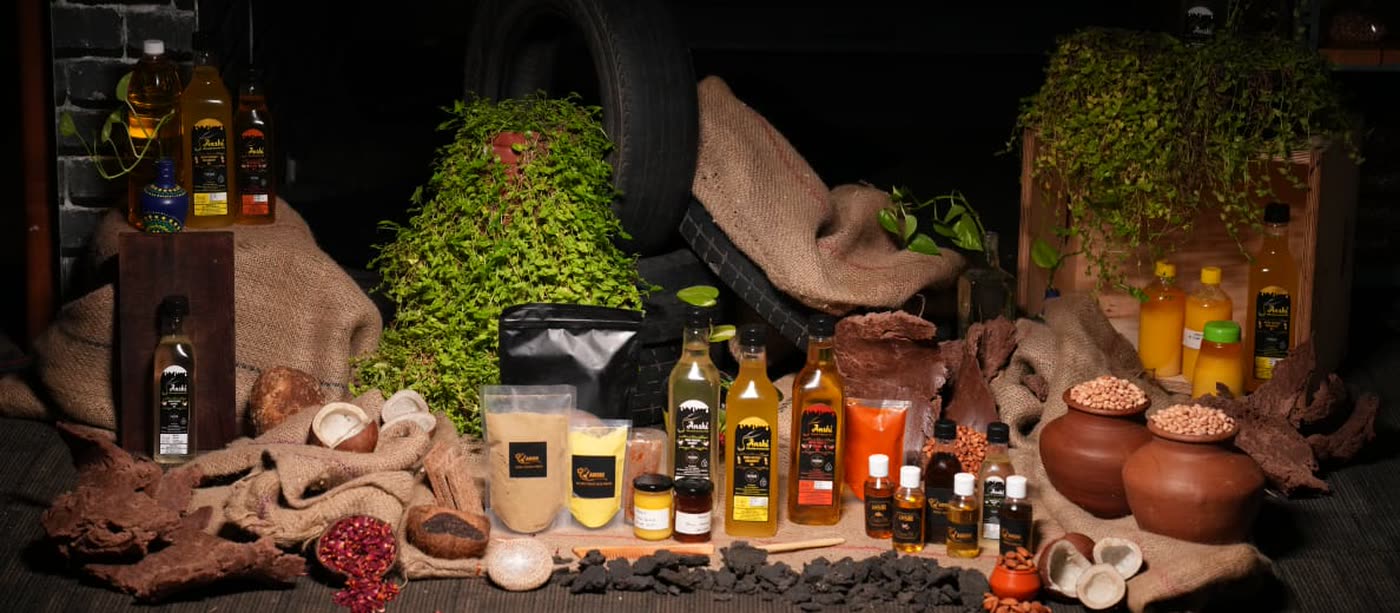
One room, one wooden press.
Groundnut, sesame, coconut and castor go into the wooden ghani in that room, and come out as oil. The ghee is made there too, over low heat, which is why it takes two days.
The rest of what we sell we do not press. The honey is gathered, the jaggery and salt are made by people we buy from, and the millets and rices are cleaned and bagged. We would rather say that plainly than let you assume we grow everything.
Wood takes the heat.
A wooden pestle turns slowly inside a wooden mortar. Wood absorbs the friction, so the oil stays near room temperature and is never cooked before it reaches the bottle.
What runs out is cloudy. The cloudiness is the seed. We let it stand in steel drums for a few days until the sediment sinks on its own, and then we bottle it. Nothing is filtered out, bleached or deodorised.
It is slower than a factory and the batches are small. That is most of the reason it costs what it costs.
What we do not claim.
We do not tell you this oil will make you healthier. We are not allowed to, and we could not prove it to you if we were.
What we can tell you is what happens to it. It is crushed in wood. It is not heated. Nothing is taken out. It is pressed in small batches and sold nearby. If that is worth more than a refined bottle, it is worth it for those reasons and not for a promise.
Unrefined oil also keeps everything that was in the seed, which means it does not want to sit in a warehouse for a year. We press small because of that, not in spite of it.
“Oil is freshly crushed, will not be old stock.”
Google review · KGF
Mostly the next street.
Forty-eight people have left a review and the rating is 5.0. Most of what we press is carried out of the shop by people who live within walking distance of it, which is the part we would least like to change.
If you are further away, we will send it anywhere in South India, and you can pay with PhonePe.